 ॐ
AI Summary
A rite done with shraddha (faith) is called Shraddh — and that faith should be sattvic. These days people take only Pitru Paksha to be Shraddh, but the shastras describe several kinds: the daily Nitya Shraddh, the Shraddh of every Amavasya, the Kamya Shraddh done with a wish, the Sapindikaran after death, and the Parvan Shraddh of Pitru Paksha. Each has its own place.
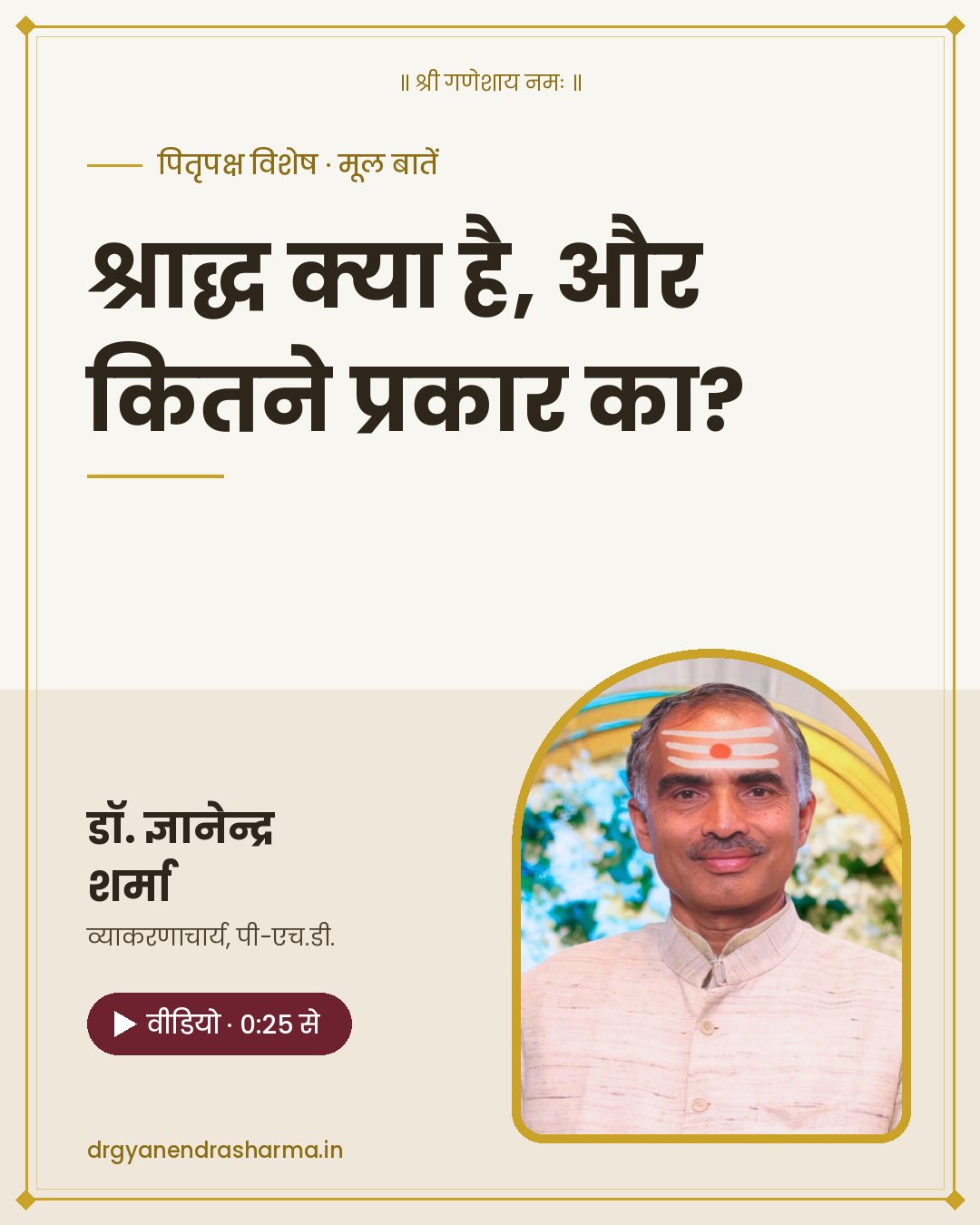
 Video (Hindi) · from 0:25What is Shraddh? The types of Shraddh — Nitya, monthly, Kamya, Sapindikaran and ParvanWatch on YouTube →
Key Takeaways
- A rite done with faith is Shraddh — and the faith should be sattvic
- Shraddh is not limited to Pitru Paksha
- The Shraddh of Amavasya keeps reaching the ancestors for a month
- Only after Sapindikaran does the departed one join the line of ancestors
- Shraddh is done according to one’s own means
The meaning of Shraddh
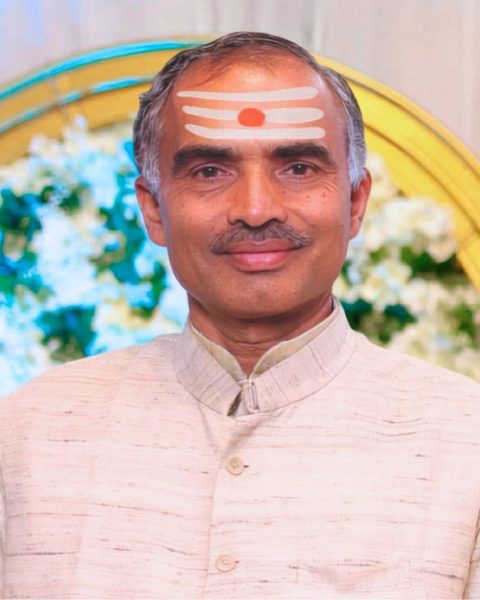
Dr. Gyanendra Sharma explains — what is done with shraddha (faith) is called Shraddh.
But faith too is of three kinds — sattvic, rajasic and tamasic. Only a rite done with sattvic faith, faith in which sattva is present, is called Shraddh. A rite done for show, or out of fear, does not give that fruit.
Is Shraddh done only in Pitru Paksha?
No. Today most people have come to think of Pitru Paksha alone as Shraddh, but earlier people performed Shraddh every month.
The reason he gives is that one of our months is one day-and-night of the ancestors. So if on Amavasya you fed a cow or a Brahmin and offered tarpan, it keeps reaching the ancestors on its own for a month.
The types of Shraddh
| Type | When | What it is |
|---|---|---|
| Nitya Shraddh | Every day | Just as there is a daily meal, there is a daily Shraddh. Its short method is given in the Nitya-karma-paddhati. |
| Amavasya Shraddh | Every month | On the Amavasya of Shraddh — it reaches the ancestors for a month. |
| Naimittik Shraddh | For an occasion | For a particular occasion or reason. |
| Kamya Shraddh | With a wish | Such as the wish for a child — a special rule for the middle pinda is given for it. |
| Sapindikaran | 11th–12th day after death | The rite that joins the departed to the line of ancestors. |
| Parvan Shraddh | Pitru Paksha | The annual Shraddh when the Sun is in Virgo. |
Why Sapindikaran is necessary
After death, for ten days the Malin Shodashi and Dashagatra rites are done, then on the 11th–12th day the Sapindikaran.
Until Sapindikaran is done, the word "preta" is spoken in the sankalp. After Sapindikaran the departed is seated in the line of ancestors — that is, with the father, grandfather and great-grandfather. Only after this does the eligibility to offer food for them arise.
Dr. Sharma stresses one point especially: the Dashagatra is the foundation of everything. Many people do not perform the rites of the ten days. If the foundation itself is not laid, then whatever you do later in Pitru Paksha, it does not reach there.
Why Pitru Paksha
When the Sun comes into Virgo (Kanya) in the year — this was called "Kanyagat Surya", which in today’s speech has become "Kanagat" — the ancestors come to the earth and reach their own homes.
What if one has no means?
This is the most important point. Shraddh is done according to one’s own means. If there are no means at all, raise your hands and simply say —
"O my ancestors, O forefathers, I have nothing. I bow to you with folded hands."
Even with this, the ancestors go away pleased. The foundation of Shraddh is not money but faith.
To read about this subject in detail, see Dr. Gyanendra Sharma’s book Pitru-Karm Shraddh-Mimansa, and the complete guide to Pitru Paksha is here.
*Source — this article is based on a video discussion by Dr. Gyanendra Sharma (video link above, in Hindi). The tithi and muhurta of Shraddh change every year — decide them only after checking with your own panchang and family purohit.*
Listen to Dr. Gyanendra Sharma (in Hindi)from 0:25 in the video · on YouTubeLooking for personal guidance? Get your birth chart analysed.
Book a consultationFrequently asked questions
What is called Shraddh? +
A rite done with sattvic faith is called Shraddh. According to Dr. Gyanendra Sharma, faith is of three kinds — sattvic, rajasic and tamasic — and only a rite done with sattvic faith is Shraddh.
How many kinds of Shraddh are there? +
Mainly the Nitya Shraddh (daily), the Amavasya Shraddh (monthly), the Naimittik Shraddh (for an occasion), the Kamya Shraddh (with a wish), the Sapindikaran (after death) and the Parvan Shraddh (in Pitru Paksha).
Why is Shraddh done on Amavasya? +
Because one of our months is one day-and-night of the ancestors. Shraddh and tarpan done on Amavasya keep reaching the ancestors for a month.
How should Shraddh be done if one has no means? +
Shraddh is done only according to one’s means. If there is nothing, raise your hands, bow to the ancestors and say that you have nothing — even with this they are pleased.