About
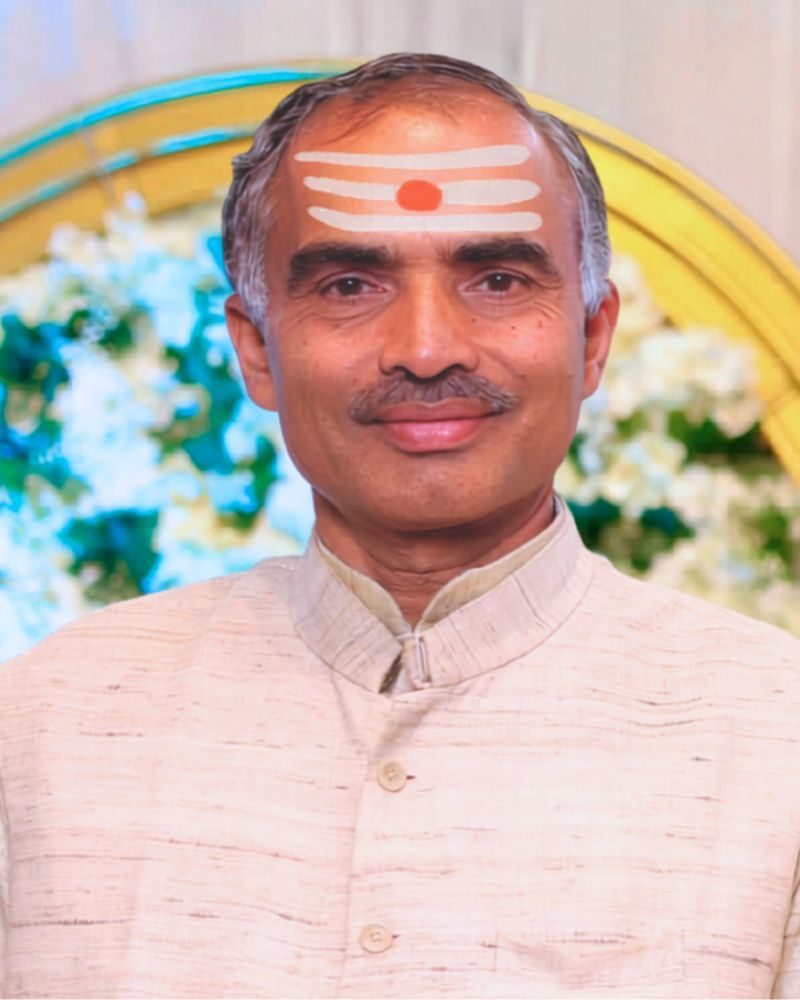
Dr. Gyanendra Sharma
Vyakaranacharya • Ph.D. (Sanskrit grammar) • Vedic astrology
His introduction and key teachings — in simple language.
Dr. Gyanendra Sharma is a Sanskrit scholar. He holds a Ph.D. in Sanskrit grammar. Shastra and jyotish have both been subjects of his study.
This is nothing new in his home. For seven generations his family has done this very work — studying, teaching and writing texts. His father, Pt. Homnidhi ji, was a Jyotishacharya. He received his first lessons in jyotish at home.
Below, in simple language, are the things he often says to people.
First teaching
Tradition does not mean walking with closed eyes
It is often said — we should do whatever our elders have been doing. Dr. Gyanendra Sharma considers this incomplete.
He recalls a verse of the Manusmriti:
येनास्य पितरो याता येन याताः पितामहाः ।
तेन यायात्सतां मार्गं तेन गच्छन्न रिष्यति ॥
Meaning — The path on which your father walked, on which your grandfather walked — walk that same path of the good; one who walks it comes to no harm.
A question arises here, and people do ask it — many people’s parents walk the wrong path too. Should the child then walk that path as well?
Dr. Gyanendra Sharma says — read the verse again. It says “satām mārgam”, that is, the path of the good. It does not say merely ‘the father’s path’.
The Veda says the same —
असतो मा सद्गमय ।
Meaning — Lead us from the untrue to the true.
So the point is simply this: wherever your elders walked the right path, follow them there. Where they did not, do not.
This lineage of his family is not hearsay — it is written in the verses of a Sanskrit text. See the seven-generation family tree →
His father
The verse no one in the assembly could complete
His first studies were at home. His father, Pt. Homnidhi Pathak ji, was a Jyotishacharya, so the talk of jyotish reached his ears from childhood.
Of him, Dr. Gyanendra Sharma says that he was like a rishi. He never wore stitched clothes in his life. For fourteen years he did not eat grain cooked on a fire. He never told a lie in his life.
The Maharishi Vidyapeeth Sansthan had opened in Noida. Scholars from all over Bharatvarsha gathered there — if there was a scholar anywhere, a vehicle would be sent to find and bring him, whatever the cost. A great Vedic conference and shastrartha was held there, attended by people from India and abroad. Maharishi Mahesh Yogi was also present.
At that time Dr. Gyanendra Sharma was studying for his Shiksha Shastri at the Lal Bahadur Shastri Sanskrit Vidyapeeth, and was sitting in the assembly, listening. There, a debate on a single word would go on for three hours, and on jyotish for hours on end.
Then the scholar conducting the session recited a verse and forgot it halfway through. He asked all the scholars sitting in the assembly — please complete it.
No one did.
Then he called out a name —
“Pt. Homnidhi Pathak, can this verse not be completed?”
The verse was from a commentary on the Jataka Parijata. It explained how to determine the lifespan of twins — because twins are born only five or ten minutes apart and the planetary positions of both are almost the same. That is why this judgement is considered very difficult.
Pt. Homnidhi ji first recited the original verse, and then its commentary too.
The verse was recited three times. It was the month of December. Scholars who prepare panchangs, such as Satyavrat ji, Priyavrat ji and Hardev ji, were also sitting in the assembly. No one could remember even one quarter of it — let alone its meaning.
Then one scholar said —
“Acharya ji, this verse is worthy of a Ph.D. There ought to be a Ph.D. on it.”
Later he also said —
“On whom should this Saraswati bestow her grace? She has nothing to do with attire. Where she resides — today we found out.”
This was said because Pt. Homnidhi ji dressed very simply — he would tie half his dhoti and wrap the other half around himself.
One day a group from this same conference set out for a meal. They were being taken by Balkrishna ji, who was a disciple of Pt. Homnidhi ji. His home lay on the way, so they all stopped there.
At that moment Pt. Homnidhi ji was cleaning the spot in the courtyard where the cow came to sit — so that it would find a proper place in the evening. Balkrishna ji introduced him as his guru ji. No one paid much attention.
Pt. Homnidhi ji said nothing. He only said — “Arre Balkrishna ji, you have done very well.”
The student who had sat in the assembly saw all this. Only one thought came to his mind —
“Can we become like this too?”
Kashi
A ticket to Banaras
On the way back from Delhi it had already been decided — he would return only after becoming a scholar.
At Delhi station he had a bag in his hand. The custom at home was to keep money inside a book — so some money was kept in a book. Right there he bought a ticket straight to Banaras. This was around 1988–89.
All he knew was that there was the Dharmasangh Vidyalaya in Varanasi — near Durgakund, founded by Dharmasamrat Swami Karpatri ji Maharaj. There, Veda, grammar, jyotish, nyaya and karmakand were taught in the traditional way.
He remembered the name of Rajendra ji there — he was the one to meet. At the gate sat Lakshman ji and Shankaranand ji. They asked — where have you come from?
The answer was — from Narwar. They had heard of Narwar.
Then a condition was set — we will take you to him, but first give the meaning of the word ‘virakta’.
He gave three meanings:
First meaning
विशेषेण आसक्तः
One who is especially attached to some one thing — he is virakta.
Second meaning
विगत-रागः
One from whose mind attachment and enmity have gone — from within whom anger, greed and delusion have left — he is virakta.
Third meaning
विष्णु-रक्तः
One who is devoted to Bhagavan Vishnu — he is virakta.
Hearing the first meaning they laughed and said — I asked from experience; today one cannot tell the difference between a householder, a saint and a brahmachari. Then he gave the second and third meanings.
Hearing all three they were very pleased, and he was given a place inside. That is where his study in Kashi began. Later he completed his Ph.D. in Sanskrit grammar.
Near the Dharmasangh is the place of Baba Kinaram, where worship is done by the tantric method. Wood comes there from Manikarnika Ghat, and havan is done with it. He went there too and bowed to the mahatma doing sadhana. The mahatma gave him bhabhut and asked for dakshina. He said — I have come to study, where would I get dakshina from? The mahatma said — take it out of the book.
That is, the mahatma knew the money was kept in the book.
Second teaching
There are three ways of talking
This distinction is very old in the shastras, but in today’s times it is perhaps more useful than ever.
Jalpa
Only speaking
Where we only want to speak and speak, not to listen. There is no room at all for what the other person says.
Vitanda
Only refuting
Where proving the other wrong is the whole aim. Ask what then is right — and there is no answer. Only ‘you are wrong’.
Vada-samvada
Where something emerges
Where both speak and both listen — and from the conversation something real emerges.
वादे वादे जायते तत्त्वबोधः ।
Meaning — It is only through discussion, again and again, that the real point is understood.
Dr. Gyanendra Sharma accepts only the third way.
You can see its effect on every page of this website — every answer is given with a reference, and nowhere is the language of fear used. What is in the shastras is written. What is not, is not written.
Third teaching
It is not right to call puja-path hypocrisy
Nowadays some people say there is no need for puja-path and karmakand — knowledge alone is enough.
Such people usually describe themselves as Advaitins. Advaita is the doctrine of Shankaracharya ji; opposite it is the doctrine of Dvaita, followed by the Vallabha Sampradaya — in which the jiva and Ishvara are regarded as separate.
Dr. Gyanendra Sharma does not agree with them. He says it is like stepping straight onto the top rung of a ladder. There are three things, and each has its own work:
॥ The work of each of the three
- Karmakand — puja, ritual, samskaras. This purifies the mind.
- Upasana — devotion and meditation. This steadies the mind.
- Jnanakand — Vedanta. This comes at the very end, and only then is it understood.
One whose mind has not been purified and who has not learnt to be steady will simply not be able to grasp the teaching of knowledge.
He also recalls the words of Tulsidas ji — one who has not attained knowledge of Brahman and has also given up karma ends up with nothing in hand.
And he adds one point that sounds simple but is deep. Advaita means where there is no second — and wherever there is thought of a second, fear arises. Prahlad was thrown from a mountain, drowned in a river, put into fire — yet he survived, because for him there was nothing but Brahman; he saw his own self in everyone.
Dr. Gyanendra Sharma says that his own faith rests not in Advaita but in Bhagavan. Lifespan, karma, how much learning one is to gain, where and through whom one is to go — all this is written by Brahma ji while one is still in the womb.
That is why he stresses one point strongly: do not tell young people that sandhya-vandan is not needed. In homes where this tradition still continues, whose yajnopavit was done at the proper time, who still do sandhya today — to break them is the greatest harm.
And refutation, too, should not be in harsh words — this he adds every time.
Fourth teaching
The shastras were not written in favour of any one group
One allegation is repeated again and again — that the texts were written by a few people for their own benefit.
Dr. Gyanendra Sharma answers this with a verse:
इदं पुण्यमिदं पापमित्यस्मिन् पदद्वये ।
आ चाण्डालं मनुष्याणां शास्त्रं समप्रयोजनम् ॥
Meaning — ‘This is merit’ and ‘this is sin’ — there are only these two things. And in both, the purpose of the shastra is the same for all human beings — even for the chandala.
That is, it was not the shastra that made distinctions.
He says the same about women. From the Manusmriti, critics pick up only the verses that contain restrictions; they do not go to the places where praise is written. And that verse too is from the same Manu:
यत्र नार्यस्तु पूज्यन्ते रमन्ते तत्र देवताः ।
Meaning — Where women are honoured, there the devatas dwell.
His view of the Manusmriti is also clear — and it differs from both sides.
He says — just as today we have our Constitution, framed by Dr. Ambedkar, by which the country is governed, so earlier there was the constitution of the rishis and maharishis. The Manusmriti was the code of the Satya Yuga. For the Kali Yuga, the Parashara Smriti is prescribed.
कलौ पाराशरः स्मृतः ।
Meaning — In the Kali Yuga, the Parashara Smriti is accepted.
And he always adds a caution: the meaning of a verse does not come from its words, it comes from the commentary. To pass judgement on any verse without reading the commentary — whether for or against — is not right.
Fifth teaching
Today’s confusion — it is of two kinds
The first is abhasa, appearance. As when someone takes a rope lying in the dark for a snake. The rope never was a snake and never will be — but that is what the viewer sees. Many misunderstandings are of this kind, and in them no one means harm.
The second is dambha, that is, pretence. About this he says it is beyond people like us to recognise it. The shastras go so far as to say that even Brahma ji himself could not get to the end of deliberate pretence.
For this he tells a story. In Brahma ji’s creation everything came into being — adharma as well as dharma. Once the grandson of Dambha reached Brahmaloka. An assembly of rishis and maharishis was in progress there. He kept Ganga water and kusha grass with him and said — so many people are sitting here, their breath will make me impure. Then he began sprinkling water with the kusha — even on Brahma ji, saying that you too have four or five mouths.
Brahma ji was very pleased. He said — what a divine soul, how refined. He took him onto his lap.
Later, on meditating, he learnt that it was Dambha’s grandson. Then Brahma ji said — when even I could not recognise you, who in the world will?
He also describes the method of pretence. To go where people do not know the shastras and spread one’s own message there. To win honour there. And at the same time to stir up hatred against learned scholars and saints — so that no one is left to check.
He neither listens to such people much, nor watches them.
But where the message is reaching new students, he does not stay silent. He says that then there is pain within — that adharma itself may come to be taken as dharma.
From his life
The hard days in Kashi
It is said of Kashi that whoever goes to live there is tested for the first six months. The same happened with him.
Lumps formed in his body and the fever rose to 107–108 degrees. He had to be admitted to the Ramakrishna Mission hospital. There was Dr. Brahmesh ji, an M.D. who had studied abroad. He said there were lumps all over the body and an operation would be needed — and the machine required for it was not there but at the hospital of Banaras Hindu University.
Dr. Gyanendra Sharma refused to go outside the parikrama of Kashi. Within him there was only one feeling — kāśyāṃ maraṇānmuktiḥ. If the body is to go, let it go in Kashi.
The hospital took his signature in advance — if the body does not survive, we bear no responsibility; write your full address. In place of the address he wrote:
माता च पार्वती देवी पिता देवो महेश्वरः ।
Meaning — My mother is Parvati, my father is Maheshvara. In this city I have no address other than this.
The doctors said — this is a spiritual matter; write the names of your worldly parents. He refused.
His elder brother came to see him on his way back from Assam. Seeing his condition he wept and asked him to come home. The reply was — I have come with a sankalp, I will not go without fulfilling it. His brother left the room weeping, without turning his back, still looking at him.
That night he recited the Gajendra Moksha the whole night through. There was great pain in his body. In the morning he said to Dr. Brahmesh ji — please give me some medicine that will relieve the pain right now. The doctor said — you are stubborn; had you gone there, everything would have been done. Then he had a tablet sent up and gave it to him, and it brought complete relief.
Later arrangements were made and a team of doctors from Banaras Hindu University came there. After a full examination the team said — “No lump is visible anywhere.” They asked what medicine had been given that made all the lumps go without an operation. When Dr. Brahmesh ji named the medicine, they said — that is a medicine for pain, not for the disease.
Many years later, around the year 2000, he had trouble in the intestines. He went to Delhi’s Govind Ballabh Pant Hospital for tests. There a senior doctor, after the tests, said what no one wants to hear. His acquaintance Jeevesh ji was with him; hearing it, he broke into a sweat.
Dr. Gyanendra Sharma said — why are you upset? This is Bhagavan’s grace. When a great illness comes, bhajan increases and attachment to the world decreases.
He told no one at home about it. The two or four people who knew were also asked not to speak of it.
He increased his bhajan — Achyutaya namah, Anantaya namah, Govindaya namah. It is said of these three names that they remove great illness. A mahatma had told him to keep water in front, chant one mala and then drink that water. But in his sankalp he never once asked for his illness to be cured.
In those days a phone call came from Vishuddhanand ji in Uttarakhand — about the admission of a disciple’s child. In the course of the conversation he learnt that Vishuddhanand ji made medicine from the gomutra of hill cows; hill cows graze on herbs, so their gomutra is considered very beneficial.
Dr. Gyanendra Sharma said nothing about himself. He simply sent a student beyond Dehradun to fetch the medicine and took it for six months. No one came to know.
Six months later he himself went to Govind Ballabh Pant Hospital again for tests. The doctor looked at the old report, then at him, and was greatly astonished.
While narrating all this, he always adds one thing:
“We wish that nothing should ever come out of our mouth that has chilli and spice mixed into it.”
One who has such an account and does not exaggerate it — his other words can be trusted.
One work
Eleven students and a hired vehicle
There is a gurukul in Avantika. There lives Mahanand Maharaj ji, who has done very severe sadhana — going to Mahendra Parvat, where no one else can. He has also done sadhana at Badrinath and at Satopanth. In the forest there is a small hut, with a gaushala nearby. He does not give discourses. You will find no publicity of his anywhere. He never asks for donations.
When Dr. Gyanendra Sharma reached there, the talk was of sankirtan. He said — sankirtan is happening everywhere today. What is disappearing is the gurukul system. This is a forest place; if an institution were to open here, perhaps this tradition would survive.
The suggestion was accepted. He did not delay.
He went straight to Karnavas, to Baikunth ji — a deeply Vedic scholar who had studied with him in Delhi. The two had long planned to open a good gurukul, with no shortage of teachers for Veda, grammar and jyotish. With his request granted, he took eleven students and one teacher. They all reached there in a hired Bolero, and Maharaj ji established the gurukul.
Today there are a hundred or two hundred students there and about two thousand cows. In every paksha a Sahasra Chandi is held — in the months of Ashwin and Chaitra the students recite a thousand paths with great purity.
He in whose hut all this began still lives in that same hut. Where all this runs from remains a mystery, even to those who live close by.
तपसा प्राप्यते स्वर्गम् ।
Meaning — Through tapas alone is heaven attained, through tapas alone is fame attained, through tapas alone is everything attained.
Special occasion
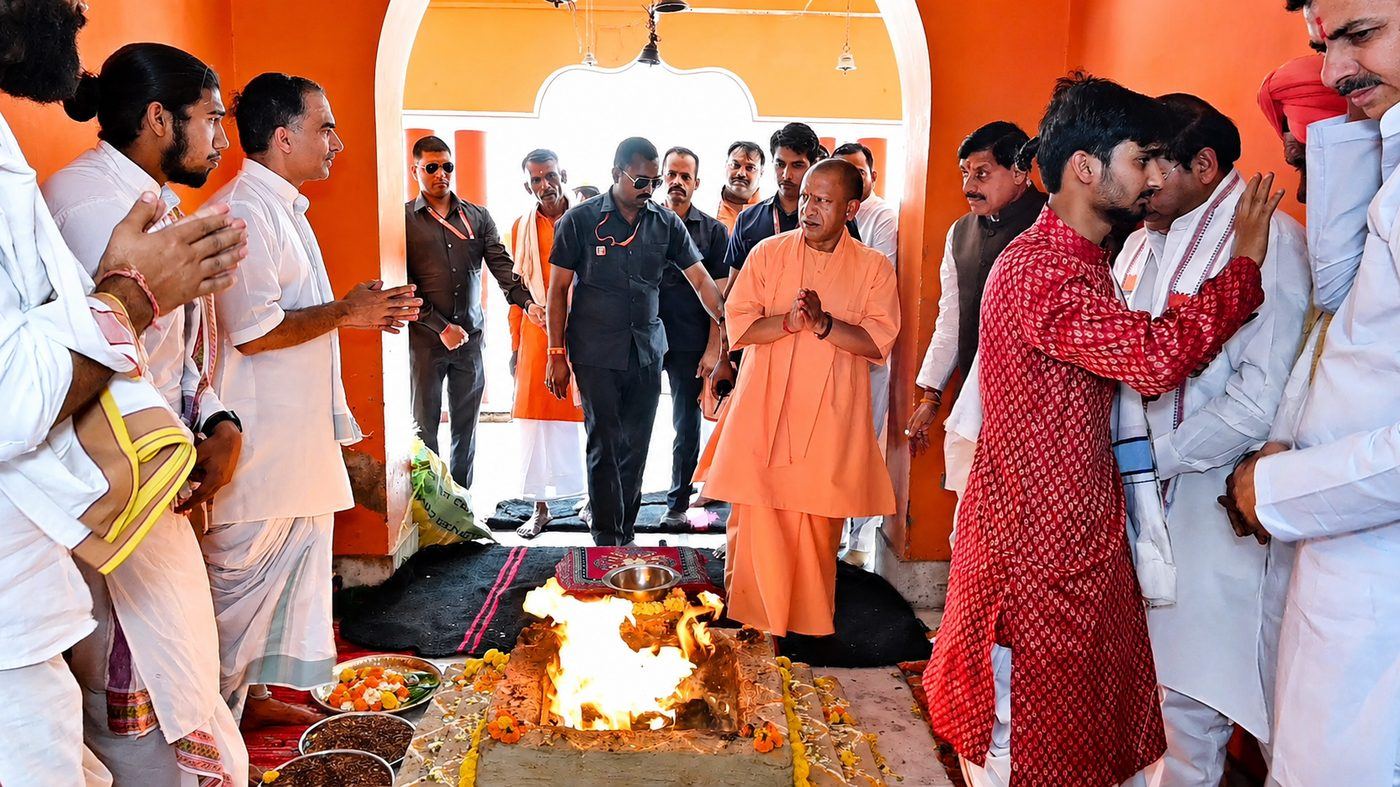
Public and spiritual participation
Honoured participation in various spiritual, cultural and social programmes.
Photo: from a public religious programme. This photo is only a record of Dr. Gyanendra Sharma’s public participation — it is not an endorsement of, or advertisement for, any person, post, political party or organisation.
Today
Why this website was made
He often repeats an old saying — the one who has teeth has no sugarcane, and the one who has sugarcane has no teeth.
In his words: there are many people like us who have learning but no reach to people — so the message stays with only a few. And of those who have reach, most do not have that learning. There are some who are truly doing the work of dharma, but they are few.
This website is meant to narrow that gap a little.
In practical terms, this means:
॥ What you receive
- He looks at every Kundli and palm himself — no one else, no software.
- The answer comes with the authority of the shastras, not by guesswork.
- No language of fear. What cannot be said is not said.
- A detailed PDF report within 24 to 48 hours.
- Every consultation is fully personal and confidential.
He is the author of the book “Pitru-Karm Shraddh-Mimansa” — answers from the shastras to questions on Pitru Dosh and Shraddh, in one place.
Further
Related pages
Family lineage
Seven generations · recorded in verse
The complete family tree from Pt. Vijaydev ji to Dr. Gyanendra Sharma, with the original verses and their meaning. →
Harihar Swami Karpatri Dharmarth Trust
The same name as the Dharmasangh where he studied
Work related to anushthan, cow-service and spreading the shastras. →
Gyan Kosh
Articles · with references
Articles on puja vidhi, vrat and festivals, shastra discussions and Sanatan Dharma. →
Show your Kundli to Dr. Gyanendra Sharma himself
He looks at every Kundli and palm himself. Detailed PDF report within 24 to 48 hours.