Pitru Paksha 2026
Pitru Paksha 2026 — our duty towards the ancestors
26 September to 10 October 2026 · Sarvapitru Amavasya — Saturday, 10 October
until Pitru Paksha begins
01 · Introduction
What Pitru Paksha is, and why
The fortnight from the full moon of Bhadrapada to the new moon of Ashwin is called Pitru Paksha. In these days we remember those ancestors because of whom we received this family, this home and this life. The shastras call it pitru-rin — the debt to the ancestors that rests on us from birth.
The very word Shraddh comes from shraddha (faith) — śraddhayā idaṃ śrāddham. A rite done with faith for the sake of the ancestors is Shraddh. That is why tradition gives more importance to the purity of feeling than to the grandeur of materials. Tarpan offered with water and sesame is considered just as fruitful as an elaborate ritual.
One thing should be made clear at the very start. Pitru Paksha is not a time of fear. Nowadays many frightening things are spread about these days — that misfortune will follow if you do not act, that the ancestors will be displeased. That is not the voice of the shastras. This is a time of gratitude, not of punishment. Whatever one can do with faith, according to one’s means, is enough.
This is the most frequently asked question. Those who do not know their ancestor’s tithi can perform Shraddh on Sarvapitru Amavasya — Saturday, 10 October 2026. This day is accepted for all ancestors whose tithi is not known. That is why it is called “Sarvapitru”.
02 · Caution
The mistakes people most often make in Shraddh
These mistakes usually happen for lack of information, not from any fault.
Going by the English date instead of the tithi. Shraddh is done on the tithi of passing, not the English calendar date. The two fall on different days every year. Learn the tithi correctly once, and then matching it with the panchang each year becomes easy.
Not paying attention to the time. For the rites of Shraddh, the middle part of the day — the Kutup and Rauhin kaal — is considered suitable. Shraddh is avoided in the early morning or after sunset. Check these times in your panchang.
Taking show to be necessary. Many people put off Shraddh thinking they cannot spend so much. The shastras do not say so. Whatever is possible according to your means — even tarpan with water and sesame — is acceptable. Shraddha is what matters; the materials are secondary.
Forgetting the gau-gras, the crow’s portion and the guest. The Shraddh meal is not limited to feeding Brahmins. There is a rule to set aside a portion for the cow, the crow, the dog, the ant and the guest. This tradition teaches us that gratitude should not be limited to one’s own family.
Not considering the recipient of the gift. The shastras say that the gift of Shraddh should be given to a worthy recipient. A gift given to one who knows the shastras and lives by them is considered meaningful. Giving to just anyone merely as a formality is not the rule.
Performing Shraddh with distress in the mind. Anger, quarrels and harsh words are said to be avoided on the day of Shraddh. A rite whose very root is shraddha loses its spirit when done with a disturbed mind. Keeping peace at home is also part of Shraddh.
Performing Shraddh out of fear. This is the biggest mistake. “If we do not do it, misfortune will follow” — this feeling is the very opposite of the root of Shraddh. Remembering the ancestors is gratitude, not a remedy done out of fear. If the feeling changes, the very meaning of the rite changes.
03 · Guidance
What to do, what not to do
What to do
- Offer tarpan with water and sesame every day — this is the simplest form
- Perform Shraddh on your ancestor’s tithi; if the tithi is not known, on Sarvapitru Amavasya
- Perform the rites of Shraddh in the middle part of the day
- Set aside the gau-gras, and keep a portion for the crow, the dog and the ant too
- Give grain, clothes or money according to your means
- Maintain peace and restraint at home
- While remembering the ancestors, speak of their virtues — tell the children too
- Whatever you do, do it with shraddha — the feeling counts for more than the quantity
What not to do
- Do not begin new auspicious undertakings, griha pravesh or a wedding
- Avoid anger, quarrels and harsh words
- On the day of Shraddh, avoid cutting hair or shaving and buying new clothes or jewellery
- Keep away from tamasic food, alcohol and meat
- Do not take loans to put on a show
- Do not do any rite out of fear or under pressure
- Do not perform the rites of Shraddh after sunset
- Do not turn away anyone who asks, or any guest, empty-handed in these days
04 · The shastric view
Pitru Dosh in the Kundli — without fear
The term “Pitru Dosh” is used today more than any other to sell fear. So it is first necessary to make clear how the shastras view it.
In the classical texts, certain planetary positions in the Kundli are seen as a dosh related to the ancestors. It is not a curse, nor a punishment. Nor does it mean that life will come to a halt or that everything will go wrong. Tradition sees it as some duty from the family’s side that remains unfulfilled and can be fulfilled.
Second — not every difficulty is Pitru Dosh. Delay in marriage, loss in business or a health problem can have many causes, and most of them have nothing to do with Pitru Dosh. One should be wary of anyone who gives the same cause for every problem.
Third — it cannot be decided without seeing the Kundli. The planetary positions are examined on the basis of the date, time and place of birth, and only then can it be said whether such a condition exists or not. Saying “you have Pitru Dosh” without seeing the Kundli is not in line with the shastras.
And if such a condition truly exists, the shastras give its remedy just as simply — Shraddh, tarpan, giving and following the family tradition. None of this is expensive or difficult.
05 · Consultation
Personalised Kundli analysis
You receive a detailed PDF report within 24 to 48 hours.
Consultation
Premium Personalised Kundli Analysis
From both perspectives — Kundli and palmistry.
Detailed PDF report · within 24 to 48 hours
All information is taken on one page, only once. Nothing is asked of you after payment.
06 · Book
Pitru-Karm Shraddh-Mimansa
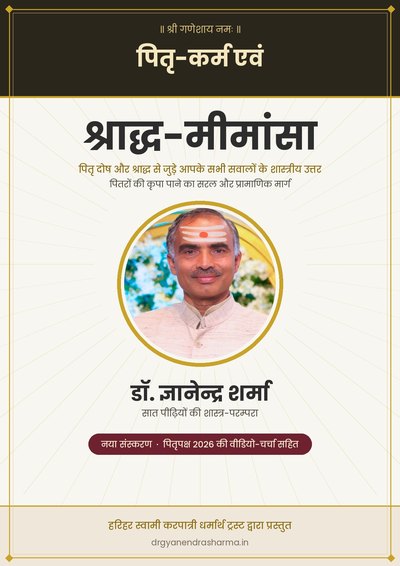
Answers from the shastras to questions on Pitru Paksha, the method of Shraddh and Pitru Dosh — in one place, with references. For those who want to understand this subject in depth.
₹199
See the books07 · Questions
Frequently asked questions
When should Shraddh be done if the ancestor’s tithi is not remembered?
On the day of Sarvapitru Amavasya. In 2026 it falls on Saturday, 10 October. This day is accepted for all ancestors whose tithi is not known — that is why it is called “Sarvapitru”. This is the most frequently asked question, and the answer is very simple.
If there is no son, who can perform Shraddh?
In the shastras the right to perform Shraddh is not limited to the son. In the absence of a son, a grandson, great-grandson, daughter, daughter’s son, brother, nephew or close relative can also perform Shraddh. There is also a provision for a wife to perform her husband’s Shraddh. It is best to decide by asking a scholar, according to your family’s tradition and circumstances.
What if one is away from home or abroad?
Place is no obstacle to Shraddh. Wherever you are, after purifying yourself you can offer tarpan with water and sesame — this is the simplest form. If pinda-daan is not possible, the rite is also completed by giving food, feeding a Brahmin or the gau-gras. Shraddha is what matters, not the place.
Why are auspicious events not held in Pitru Paksha?
It is important to understand that Pitru Paksha is not an inauspicious period. In tradition, new auspicious undertakings are postponed in these days so that the mind, time and resources remain devoted to pitru-karm. This restraint is for the sake of focus, not out of fear. Work already under way and daily activities continue as usual.
Is it necessary to spend a lot on Shraddh?
Not at all. The shastras clearly say that Shraddh should be done according to one’s means. Tarpan with water and sesame, the gau-gras, and whatever giving is possible — this is enough. Taking loans to put on a show is not in line with the shastras.
How is Pitru Dosh identified?
Only by looking at the Kundli. The planetary positions are studied on the basis of the date, time and place of birth, and only then can it be said whether such a condition exists or not. It is not right to tell anyone “you have Pitru Dosh” without seeing the Kundli. And if the condition is not present, the analysis says exactly that, clearly.
If you would like your Kundli seen
Birth details and a photo of the palm — on one page. Report within 24 to 48 hours.
Start a consultation