 ॐ
AI Summary
Manglik Dosh (Mangal Dosh) is formed when Mars is placed in the 1st, 4th, 7th, 8th or 12th house from the lagna in the birth chart. It is found in about 40% of charts, so it is not some rare ‘curse’. In many yogas the dosh is cancelled on its own. Decide on marriage only through a full Kundli matching; the main remedies are the Tuesday fast, worship of Hanuman, the Mangal mantra and daan.
Key Takeaways
- If Mars is in the 1st, 4th, 7th, 8th or 12th house from the lagna, the Manglik yoga is formed (some traditions also count the 2nd house).
- This position occurs in about 40% of charts — it is not a rare dosh, but a common planetary position.
- In many situations the dosh is cancelled on its own (parihara) — so a full analysis is necessary before any decision.
- When both charts have the same Manglik position, it is not considered an obstacle to marriage.
- The remedies are simple and sattvic — fasting, mantra, daan; fear or expensive rituals are not compulsory.
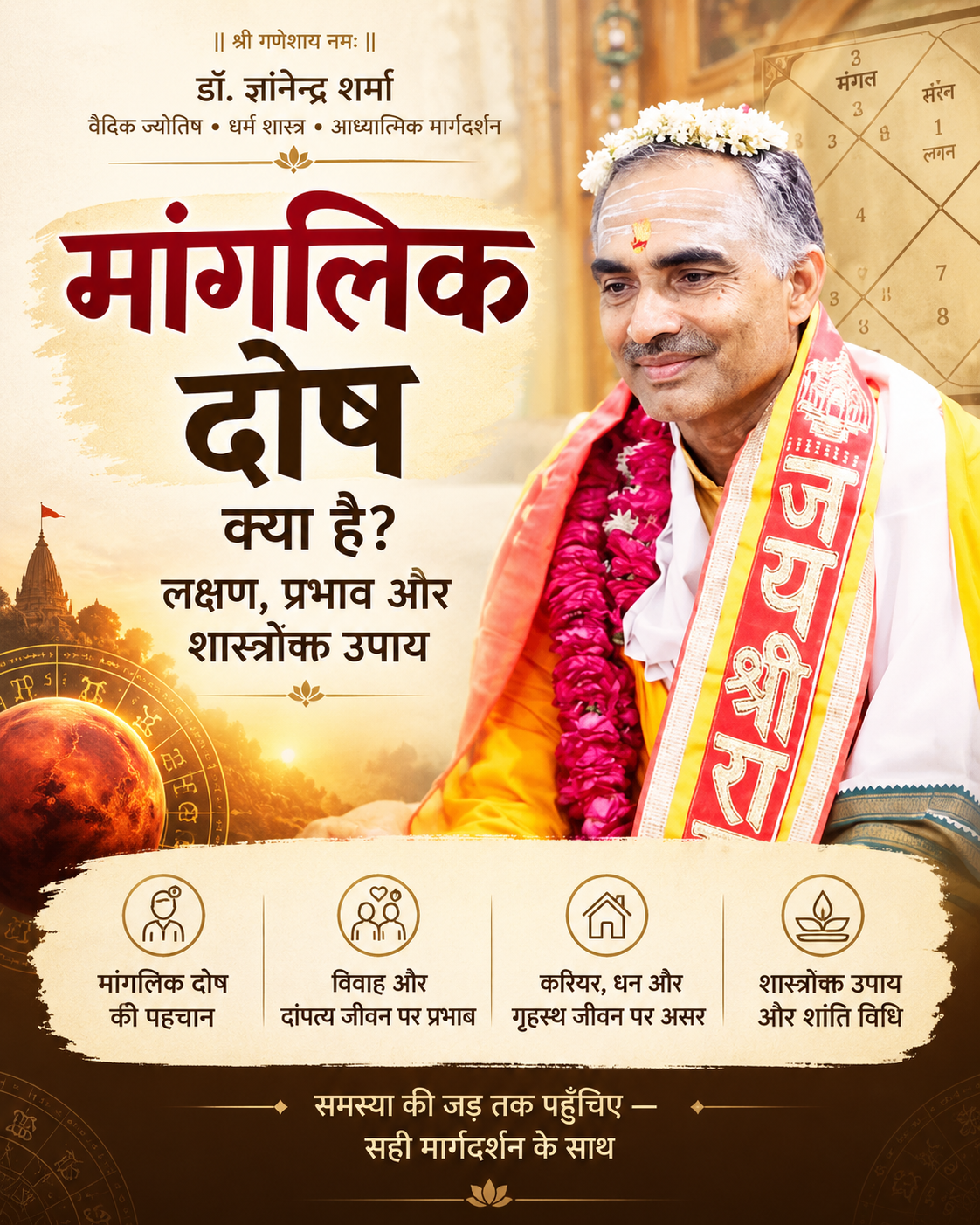
As soon as marriage is discussed, one word often worries families — "Manglik". Someone says there is Mangal Dosh in the chart, and discussions begin at home. But did you know that this position is found in roughly two out of every five charts? In this article we will understand, on the basis of the shastras, what Manglik Dosh really is, when it is effective, when it is cancelled on its own, and what its authentic remedies are — without any fear.
What is Manglik Dosh?
In Vedic astrology Mars is regarded as the significator of courage, energy, land and blood. Mars is fiery by nature. When it is placed in certain houses of the birth chart — especially the houses connected with marriage and married life — its fiery energy can affect the areas of married life. This position is called Manglik Dosh, Mangal Dosh or Kuja Dosh.
धने व्यये च पाताले जामित्रे चाष्टमे कुजे।
कन्या भर्तृविनाशाय भर्ता कन्याविनाशकः॥ — a well-known verse cited in jyotish texts (indicating the house positions)
Note — such statements in the shastras are meant to caution, not to frighten. The same texts also give many rules for the cancellation of the dosh, which are seldom discussed.
How is Mangal Dosh formed in the Kundli?
Counting from the lagna (first house), when Mars sits in the following houses, the Manglik yoga is formed. Many scholars also make the same calculation from the Moon chart and from Venus — which is why the intensity of the dosh differs in every chart.
| Position of Mars | Area of the house | Possible effect |
|---|---|---|
| First house (lagna) | Nature, personality | Fiery temperament, clashes of ego |
| Fourth house | Domestic happiness, family peace | Domestic quarrels, change of residence |
| Seventh house | Marriage, life partner | Tension in married life, delay |
| Eighth house | Longevity, marital happiness | Health concerns, instability |
| Twelfth house | Comfort of the bed, expenditure | Mental unrest, distance |
In some traditions (especially in South India) the second house is also counted. This is why one person may call the same chart ‘Manglik’ and another ‘partly Manglik’ — it is your right to ask which method of calculation is used.
What are the signs and effects of Manglik Dosh?
It is important to understand that Mangal Dosh does not mean a certain inauspicious result. Jyotish is a shastra of possibilities. Effects appear only when the dasha, transits and other planetary yogas also point in the same direction. Generally, the areas where alertness is useful are:
- Delay in marriage — proposals stopping just as they are about to be settled.
- Sharp differences in married life — big clashes over small things.
- Imbalance of energy — anger, impatience, haste in decisions.
- Health alertness — caution in matters of blood, bile and injury.
Remember — this same Mars also makes a person brave, hard-working and a leader. Many people who succeed in the army, the police, surgery, sport and land business have a strong Mars in their charts.
Is Manglik Dosh always inauspicious? (Rules of cancellation)
No. The shastras describe many situations of parihara (cancellation) of Mangal Dosh. Some of the main ones:
- Ubhaya-Manglik yoga: if the charts of both bride and groom have the same Manglik position, the dosh is considered mutually pacified.
- Mars in own sign / exalted: if Mars is in Aries or Scorpio (own sign) or Capricorn (exaltation), the strength of the dosh becomes very weak.
- Benefic aspect: if a strong Jupiter or Venus aspects Mars, its fieriness is balanced.
- Particular house positions: many texts give exceptions for house positions in particular signs (for example, Mars in Cancer or Capricorn is not considered to cause the dosh in some houses).
That is why rejecting a proposal merely on hearing “is Manglik” is not in line with the shastras — it is a decision taken on incomplete information. In a full Kundli matching, both the intensity of Mangal Dosh and the cancelling yogas are examined along with the guna matching.
What are the remedies for Manglik Dosh in the shastras?
The aim of a remedy is not to suppress the energy of Mars, but to balance it and direct it into good action. Authentic and sattvic remedies:
- Tuesday fast — according to your faith, with a balanced diet.
- Worship of Hanuman — the Hanuman Chalisa daily; reciting the Sundarkand on Tuesdays is especially fruitful.
- Japa of the Mangal mantra — "ॐ अं अंगारकाय नमः" or "ॐ क्रां क्रीं क्रौं सः भौमाय नमः" (a regular number, according to your capacity).
- Daan — giving masoor dal, jaggery, red cloth or copper on Tuesday.
- Traditions such as Kumbh / Vishnu Vivah — only when a qualified astrologer confirms the intensity of the dosh. It is not compulsory for every Manglik.
- Moonga (red coral) gemstone — only after examining the chart; an unsuitable gem can do harm instead of good.
Why is Kundli matching necessary before marriage?
Mangal Dosh is only one part of Kundli matching. Ashtakoot guna matching, the seventh house of both charts, the positions of Venus and Jupiter, the combination of dashas and mental compatibility — only the combined study of all these gives a clear picture for a marriage decision. An experienced astrologer will also tell you which worry is groundless — and that is the mark of authentic jyotish.
For a marriage decision, the Kundli + Palmistry Analysis is the most suitable plan. To understand the tradition of fasting, also see the complete guide to the Ekadashi fast.
Looking for personal guidance? Get your birth chart analysed.
Book a consultationFrequently asked questions
Can a Manglik person marry a non-Manglik? +
Yes, in many situations. Mangal Dosh is cancelled on its own in many yogas — such as the same house position in both charts, Mars in its own sign or sign of exaltation, or the strong influence of other benefic planets. The decision should always be made only after a full Kundli matching, not merely on hearing the word ‘Manglik’.
In what percentage of charts is Manglik Dosh found? +
Mars creates the Manglik position in 5 of the 12 houses (1, 4, 7, 8 and 12 from the lagna), so by a simple count the Mangal Dosh position is found in about 40% of charts. There is no need to be afraid of so common a position — what matters is the intensity of the dosh and the check for cancelling yogas.
Does Mangal Dosh end with age? +
In folk tradition it is believed that the effect of Mangal Dosh weakens after the age of 28. From the shastric point of view the dosh remains in the chart, but the period of its results changes according to the mahadasha-antardasha of Mars and transits. A personal analysis of the chart is needed for an accurate assessment.
Which remedy for Manglik Dosh is the most effective? +
The most effective remedy is specific to the chart. Generally, the Tuesday fast, regular recitation of the Hanuman Chalisa, japa of the Mangal mantra, and giving masoor dal, jaggery and red cloth are considered auspicious. Before any major remedy (such as Kumbh Vivah), be sure to have the dosh confirmed by a qualified astrologer.