 ॐ
AI Summary
The Shraddh meal should be given only to one who is worthy — a Brahmin who knows the Veda with its meaning and performs sandhya-vandan. Time matters greatly too: the ancestors’ time is Kutup kaal, which begins at about half past eleven. A meal at 8–9 am falls in the ancestors’ midnight, so it does not reach them. A Brahmin eats the meal of only one Shraddh that day. If no worthy recipient is found, feed a desi cow.
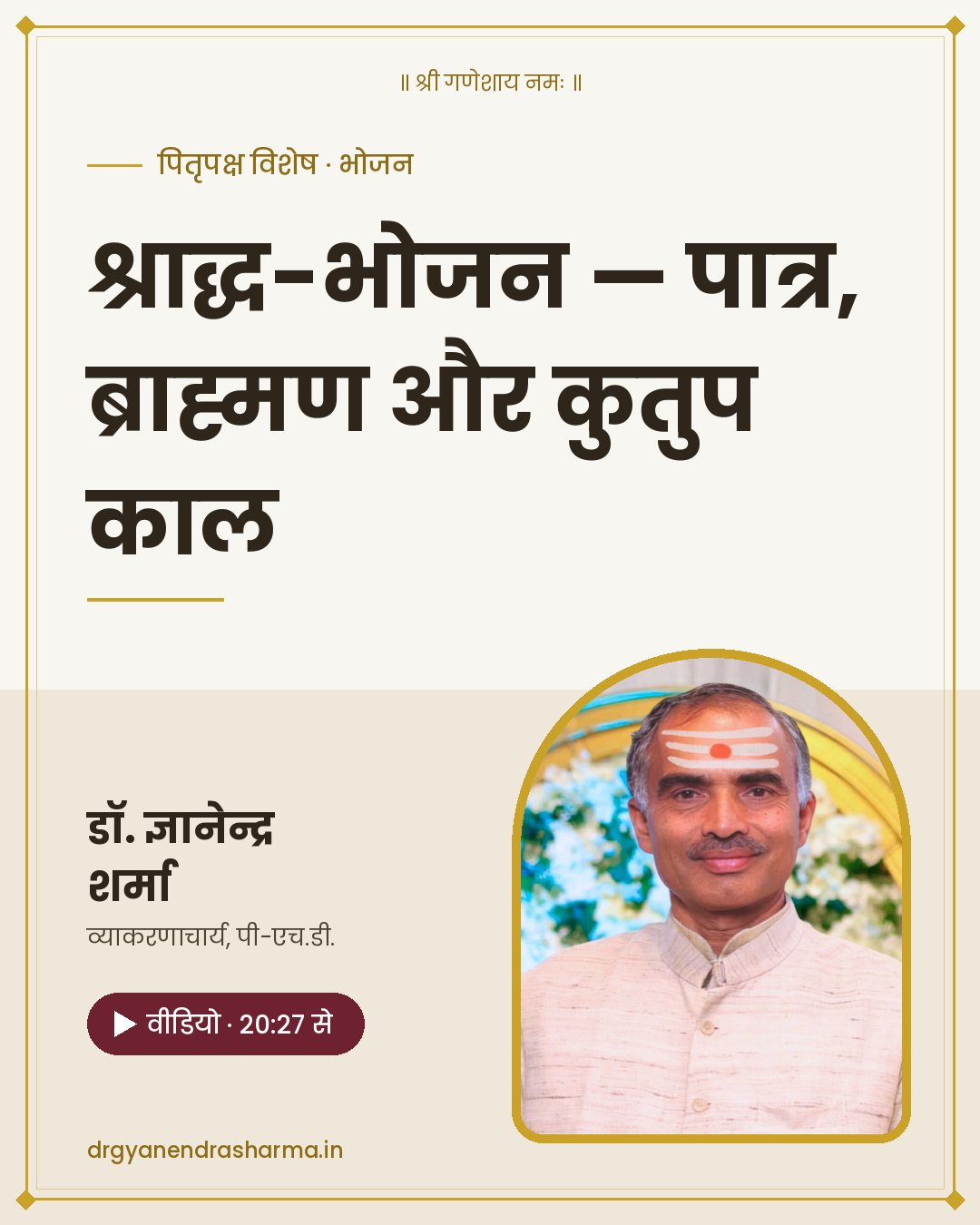
 Video (Hindi) · from 20:27The Shraddh meal: who is a worthy Brahmin, the right time for the meal (Kutup kaal) and the essential rulesWatch on YouTube →
Key Takeaways
- The ancestors’ mealtime is Kutup kaal — from about 11:30
- A Shraddh meal at 8–9 am does not reach the ancestors
- After accepting the invitation, the Brahmin does not eat again that day
- Even if wealthy, do not expand too much — if there is only one worthy person, feed only one
- If no worthy Brahmin is found, feed a desi cow
Who is a worthy Brahmin
Dr. Gyanendra Sharma gives the order laid down in the shastras —
- One who knows the Self and is established in it — who sees the world as illusory and is content with whatever comes. This is the best.
- If such a one is not found, a yogi.
- If not, one who knows the Veda with its meaning — not one who has merely memorised the mantras.
- If not even that, a Brahmin of a good family, in whose lineage there has been no great sinner or person of bad conduct.
The right time for the meal — Kutup kaal
The shastras divide the day — the time before noon belongs to the devatas, midday to the guest, and the afternoon Kutup kaal to the ancestors. It is considered to begin at about half past eleven and last until three in the afternoon.
Why not a Shraddh at 8 am
Many people say — I have to go to the office, we will serve the meal before 9. Dr. Sharma explains why this does not work:
When it is 12 noon for us, it is 4 am for the ancestors. Our 1 pm is their 5 am, our 3 pm is their 7–8 am.
By this reckoning, if you served the meal at 8–9 am, it was the ancestors’ midnight. A meal at that time does not reach the ancestors.
काललोपो न कर्तव्यः — the time set for a rite is the time it is done. One’s own convenience is not considered in this.
One Brahmin, one day, one meal
Worthy Brahmins are few, so invitations from four homes reach the same Brahmin — "come to us at 1, to them at 2."
This is not done. As soon as the invitation to a Shraddh is accepted, a discipline applies to that Brahmin —
- No second meal that day
- No travel — the day before and that day
- No carrying loads on the head
- Observing brahmacharya
And this discipline applies equally to the one performing the Shraddh.
Who cannot take the meal
- Two real brothers, or father and son — do not eat together at the same Shraddh. Only one will.
- Parivetta — a younger brother who married before his elder brother.
- Those who practise jyotish or medicine as a trade.
Whom to be sure to invite
The sister’s son, the son-in-law, the sister’s husband, the family guru and the family purohit — the restrictions above do not apply to them. They should certainly be included in the Shraddh.
The shastras name three pure things of Shraddh —
त्रीणि श्राद्धे पवित्राणि दौहित्रः कुतपस्तिलाः ।
Meaning — three things are pure in Shraddh: the daughter’s son, Kutup kaal, and sesame.
"Let us feed the whole village" — is that right?
Dr. Sharma says — even if one is wealthy, one should not expand the Shraddh too much. The reason: the Shraddh meal should be cooked only by people of one’s own gotra, the place should be pure, and the time correct. Family members simply cannot cook a meal for fifty people.
So — if one worthy person is found, one; if three, three. If there is one worthy person and the rest are unworthy, feed only the one.
If no worthy person is found
The alternative is a desi cow. The cow and the Brahmin are considered to be of one family — in one dwell the mantras, in the other the havi (oblation). Food given to a cow also reaches the ancestors.
Before the meal
Give the Brahmin a seat, wash his feet, have him do achaman — then the meal. Seating him straight down to eat makes the ancestors return disappointed. While washing the feet, the wife should be on the left.
To read about this subject in detail, see Dr. Gyanendra Sharma’s book Pitru-Karm Shraddh-Mimansa, and the complete guide to Pitru Paksha is here.
*Source — this article is based on a video discussion by Dr. Gyanendra Sharma (video link above, in Hindi). The tithi and muhurta of Shraddh change every year — decide them only after checking with your own panchang and family purohit.*
Listen to Dr. Gyanendra Sharma (in Hindi)from 20:27 in the video · on YouTubeLooking for personal guidance? Get your birth chart analysed.
Book a consultationFrequently asked questions
At what time should the Shraddh meal be served? +
In Kutup kaal, which is considered to begin at about half past eleven and last until three in the afternoon. This is the ancestors’ mealtime.
Can the Shraddh meal be served at 8–9 am? +
No. When it is 12 noon in our day, it is 4 am for the ancestors, so 8–9 am is their midnight and a meal at that time does not reach them.
Can a Brahmin take the Shraddh meal at several homes in one day? +
No. After accepting a Shraddh invitation, the Brahmin does not eat again that day. Travel and carrying loads are also forbidden.
What should be done if no worthy Brahmin is found? +
Feed a desi cow. The shastras regard the cow and the Brahmin as of one family, so food given to a cow also reaches the ancestors.
Can two real brothers take the meal at the same Shraddh? +
No. Two real brothers or a father and son do not eat together at the same Shraddh — only one of them will.