 ॐ
AI Summary
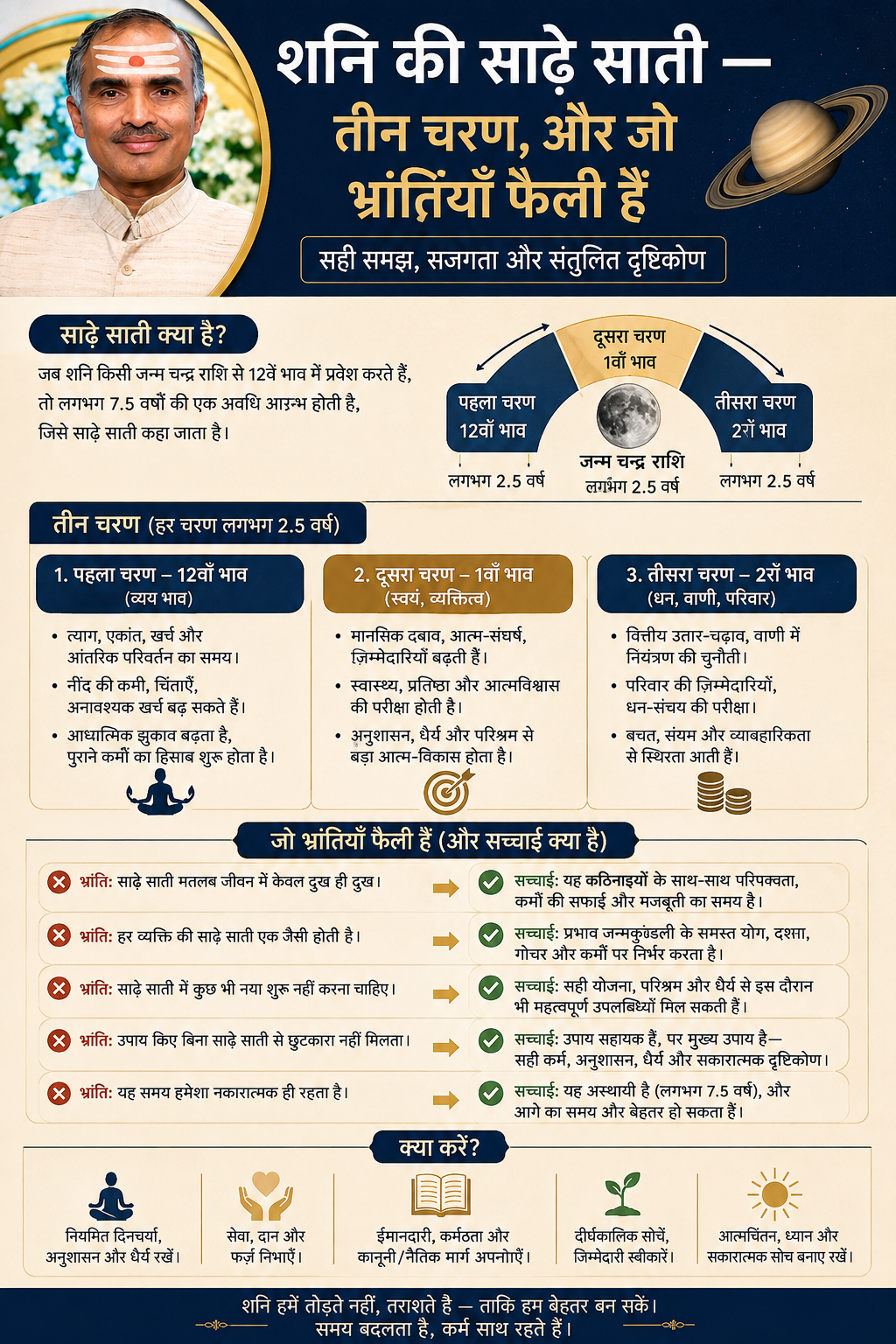
Sade Sati is the period when transiting Saturn passes through the twelfth sign from the natal Moon sign, then that sign itself, and then the second sign. Saturn stays about two and a half years in a sign, so the period lasts about seven and a half years. It comes about three times in a lifetime. Tradition calls it a time of hard work, responsibility and maturity — not only of difficulty.
Key Takeaways
- Sade Sati is counted from the natal Moon sign, not the Sun sign.
- Saturn stays about two and a half years in a sign — three signs together make about seven and a half years.
- The three phases are not alike in nature; the middle phase is usually the one most felt.
- This period comes about three times in a lifetime — and each time the experience differs with age.
- Tradition calls Saturn the giver of the fruits of karma — not the giver of punishment. This distinction must be understood.
"Sade Sati is running" — on hearing this, many people’s hearts sink. But knowing what this period really is, on what basis it is counted, and how the shastras view it, is far more useful than that fear.
How Sade Sati is counted
When transiting Saturn enters the twelfth sign from the sign of the Moon in the birth chart, Sade Sati is considered to begin. From there it comes into the Moon sign, and then into the sign after it. The period is complete after it has crossed these three signs.
Saturn stays about two and a half years in a sign. Three signs — so about seven and a half years ("sade saat"). That is where the name comes from.
One point deserves special attention: this calculation is from the Moon sign, not the Sun sign. Many people look at their Sun sign and assume they are in Sade Sati — such a calculation stands on the wrong basis.
Three phases, three different natures
| Phase | Position of Saturn | What tradition considers |
|---|---|---|
| First | Twelfth sign from the Moon | Expenditure, travel, sleep and health; growing responsibilities |
| Middle | The Moon’s own sign | The greatest weight on the mind; decisions and relationships |
| Last | Second sign from the Moon | Matters of wealth, family and speech |
It is not right to weigh all three phases on the same scale. Usually the middle phase is felt the most, because at that time Saturn passes over the Moon, and the Moon is the significator of the mind.
It is not the same for everyone — this is the most important point
The result of Sade Sati is not the same for every person. The things that make the difference:
- Saturn’s own position in the birth chart — in which house, in which sign
- Whether Saturn is a benefic or a maraka for the lagna — this changes with the lagna
- The dasha-antardasha running at the time
- Age — a Sade Sati at twenty and a Sade Sati at sixty are not the same experience
- The strength of the Moon in the birth chart
That is why saying "Sade Sati is running, now nothing can be done" is not in line with the shastras.
Saturn — the giver of the fruits of karma, not of punishment
Tradition calls Saturn karmaphaladata — the giver of the fruits of karma. The word is worth looking at closely — one who gives fruit, not one who gives punishment. What Saturn gives is considered the result of actions done.
Saturn delays, but what it gives, lasts — that is the view of tradition.
For this reason, calling Sade Sati only a period of difficulty is half the story. Tradition also calls it a period of hard work, responsibility and maturity. Many people have built the most solid parts of their lives in this very period.
What tradition says for this period
The things mentioned in the shastras and in folk tradition:
- The Saturday fast and the gift of oil
- Worship of Hanuman ji
- Japa of the Shani mantra
- Giving black sesame, urad, iron and clothes
- Respect for the elderly, labourers and servants — Saturn is regarded as their significator
None of these is expensive or difficult. And no remedy gives an assurance of any certain result — remedies are part of conduct and inner attitude.
What should not be done
- Counting Sade Sati from the Sun sign and nursing needless worry
- Getting expensive rituals done merely in the name of Sade Sati
- Putting even the ordinary ups and downs of life on the account of Sade Sati
- Putting off decisions — Saturn is the significator of delay, but it does not command inaction
Seen with understanding, Sade Sati is a period of time, not a sentence of punishment. And what is a period of time also passes.
Looking for personal guidance? Get your birth chart analysed.
Book a consultationFrequently asked questions
From which sign is Sade Sati counted? +
Sade Sati is counted from the sign of the Moon in the birth chart, not the Sun sign. It begins when transiting Saturn comes into the twelfth sign from the Moon sign, and is complete when it crosses the second sign from the Moon sign.
How many years does Sade Sati last, and how many times does it come in a life? +
Saturn stays about two and a half years in a sign and crosses three signs in Sade Sati, so the period lasts about seven and a half years. As one cycle of Saturn takes about thirty years, this period usually comes three times in a life.
Are all three phases of Sade Sati alike? +
No. In the first phase Saturn is in the twelfth sign from the Moon, in the middle phase in the Moon’s own sign, and in the last phase in the second sign from the Moon. Each covers a different area. The middle phase is usually felt the most, because at that time Saturn passes over the Moon, the significator of the mind.
Is Sade Sati painful for everyone? +
No. The result depends on Saturn’s own position in the birth chart, Saturn’s nature for the lagna, the running dasha and age. Tradition calls Saturn the giver of the fruits of karma — not the giver of punishment. Many people have built the most solid parts of their lives in this very period.
Which remedies does tradition speak of during Sade Sati? +
The main ones are the Saturday fast and the gift of oil, worship of Hanuman ji, japa of the Shani mantra, and giving black sesame, urad, iron and clothes. Along with respect for the elderly, labourers and servants, since Saturn is regarded as their significator. These remedies are part of conduct and give no assurance of any certain result.