 ॐ
AI Summary
The common method of Kundli matching is Ashtakoot, in which eight kootas together carry 36 gunas. Generally, a match of 18 or more gunas is considered acceptable. But in the shastras the count of gunas is not the final word — the position of Mars, the seventh house, the dasha of both charts and longevity and health must also be considered. Nadi and Bhakoot dosh also have remedies (parihara) laid down in the shastras.
Key Takeaways
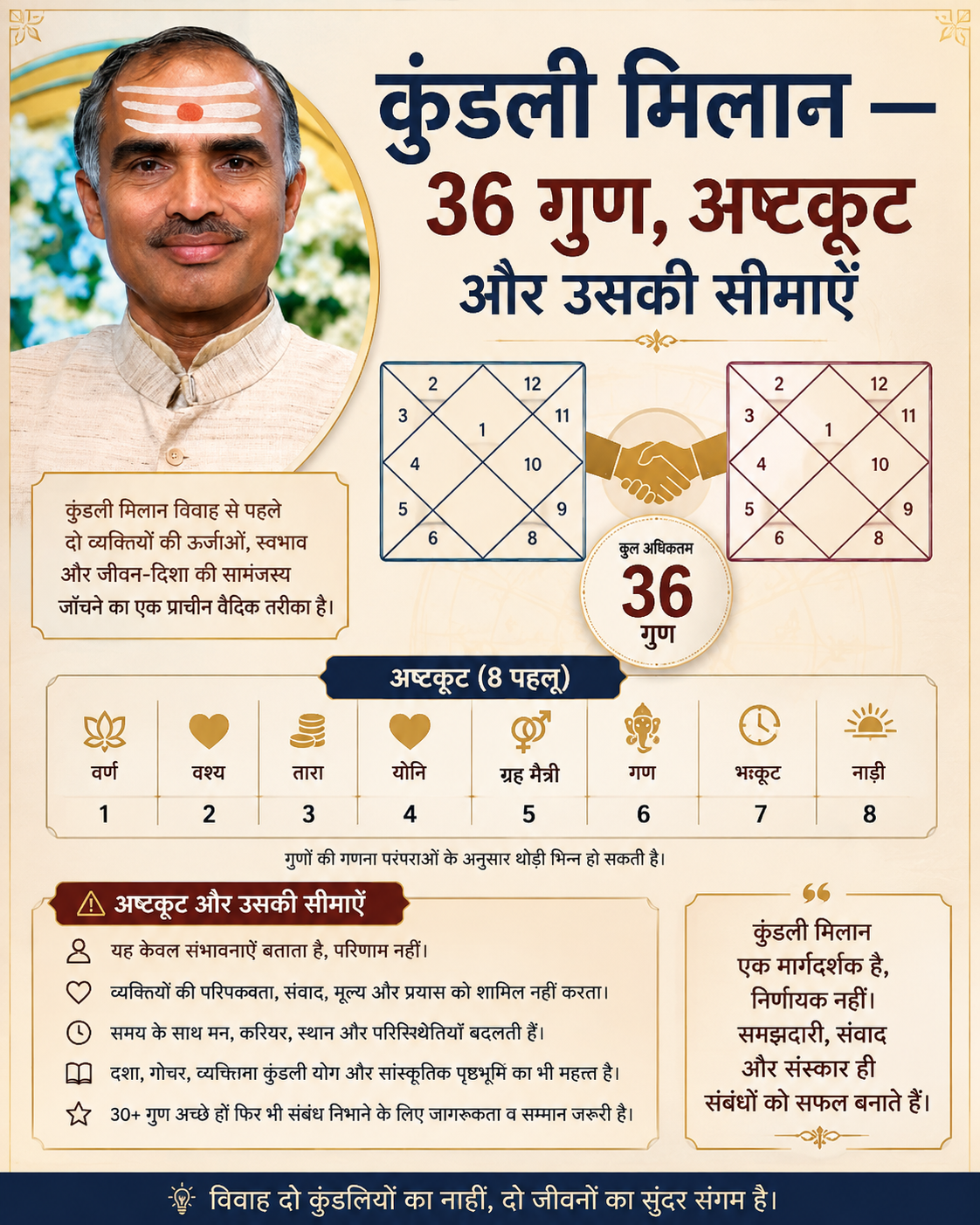
- Ashtakoot has eight kootas — Varna, Vashya, Tara, Yoni, Graha Maitri, Gana, Bhakoot and Nadi; together they carry 36 gunas.
- In common tradition, more than 18 gunas is considered acceptable — but this is an indication, not a rule.
- Nadi (8) and Bhakoot (7) carry the most weight — which is why they also cause the most confusion.
- Even with many gunas, a decision is incomplete without looking at the position of Mars, the seventh house and the running dasha.
- The shastras are just as clear about the cancellation of doshas as about the doshas themselves — telling only half the story is not right.
As soon as marriage is discussed, the first question asked is — "How many gunas matched?" And often the answer is given as a single number. But where this number comes from, on what basis it is built, and how far it can go on its own — that is seldom asked.
What is Ashtakoot matching?
The matching method common in North India is called Ashtakoot. In it, eight criteria are considered on the basis of the Moon nakshatra and Moon sign of the bride and groom. Each criterion has its own weight, and the eight together add up to 36.
| Koota | Gunas | What it considers |
|---|---|---|
| Varna | 1 | Mental and spiritual level |
| Vashya | 2 | Mutual attraction and influence |
| Tara | 3 | Health and well-being from the birth nakshatra |
| Yoni | 4 | Physical and natural compatibility |
| Graha Maitri | 5 | Friendship between the sign lords |
| Gana | 6 | Temperament — Deva, Manushya, Rakshasa |
| Bhakoot | 7 | The relative position of the signs |
| Nadi | 8 | Adi, Madhya, Antya — children and health |
The point to note is that all eight kootas are based only on the Moon nakshatra. The full chart contains much more that this calculation does not even touch.
Where did the rule of 18 gunas come from?
In common tradition, a match of 18 or more gunas is considered acceptable, and below 18 a reconsideration is suggested.
But this "rule" is not as strict as it is taken to be. It is a practical indication — a boundary line that shows where a deeper look is needed. Even with 32 gunas, if the seventh house is afflicted, consideration is needed; and even at 20 gunas, if the rest of the chart is strong, there is no cause for worry.
The count of gunas is the beginning of the question, not the answer.
Nadi dosh — the most weight, the most confusion
The Nadi koota carries 8 gunas — the most of the eight. Three nadis are recognised: Adi, Madhya and Antya. If the bride and groom have the same nadi, Nadi dosh is considered present and its 8 gunas become zero.
That is why Nadi dosh is thought to be the heaviest. But the shastras also give its parihara. Generally, Nadi dosh is considered cancelled in these situations:
- Both have the same sign but different nakshatras
- Both have the same nakshatra but different padas
- Both have the same sign lord
- The sign lords are friends of each other
This list varies a little between traditions. That is why it is not right to decide merely on hearing "there is Nadi dosh" — one must see whether a parihara applies.
Bhakoot dosh
Bhakoot carries 7 gunas. If the Moon signs of the bride and groom stand in a 6-8, 9-5 or 2-12 relationship, Bhakoot dosh is considered present.
This too has a parihara — if the lords of both signs are the same, or are friends of each other, the dosh is usually considered ineffective.
What Ashtakoot does not look at
This is the most important point, and the least spoken of. Ashtakoot matching does not even touch these things:
- The position of Mars — the Manglik yoga is considered separately; it is not part of the 36 gunas
- The seventh house and its lord — this is the main house of marriage
- The running dasha-antardasha of both — the timing of marriage is tied to this
- The eighth house — longevity and stability
- The second house — family and speech
That is why the tradition never gave decisions by counting gunas alone. Guna matching is a sieve — for the first sorting. After that, the full chart is examined.
How should the decision be made?
- Do not take the number of gunas as the final verdict — take it as the first indication
- Where a dosh is pointed out, also ask about the parihara — the shastras contain both
- The seventh house and Mars of both charts must be examined
- Where the shastra is not clear, no claim of a certain outcome should be made
A marriage is a bond not of two charts but of two families and two people. Jyotish offers one view of it — not the whole decision.
Looking for personal guidance? Get your birth chart analysed.
Book a consultationFrequently asked questions
How many gunas should match in Kundli matching? +
In common tradition, 18 or more gunas is considered acceptable, and below 18 a reconsideration is suggested. But this is not a strict rule — it is a practical indication. Even with many gunas, a decision is incomplete without looking at the seventh house, the position of Mars and the running dasha of both.
Can there be no marriage if there is Nadi dosh? +
Saying so would be only half the story. The Nadi koota carries 8 gunas, so it seems the heaviest. But the shastras also give its parihara — such as the same sign but different nakshatras, the same nakshatra but different padas, or the same sign lord or sign lords who are friends. A decision is not right without seeing whether a parihara applies.
What is not looked at in Ashtakoot matching? +
Ashtakoot is based only on the Moon nakshatra and Moon sign. It does not include the position of Mars, the seventh house and its lord, the eighth house, or the running dasha-antardasha of both. These must be examined separately.
What is the parihara of Bhakoot dosh? +
If the Moon signs of the bride and groom stand in a 6-8, 9-5 or 2-12 relationship, Bhakoot dosh is considered present. According to tradition, if the lords of both signs are the same, or are friends of each other, the dosh is usually considered ineffective.
Should a marriage be decided by guna matching alone? +
No. Guna matching is the first sorting, not the final decision. In tradition, after guna matching the full chart is considered — including the seventh house, Mars, the sequence of dashas, and longevity and health. A marriage is a bond not of two charts but of two people and two families.