 ॐ
AI Summary
At a Veda Vidyalaya in Delhi, founded four years ago, Dr. Gyanendra Sharma gave a discourse to Veda students and their teachers. He explained that an acharya is one who knows the meaning of the shastras, establishes the disciple in right conduct, and lives that way himself. Through the story of Shankha and Likhita he showed that taking someone’s thing without asking is also a fault. He also spoke at length on the honour of the mother, the idea of the wife as ardhangini, and the four marks of dharma — the Veda, the smriti, good conduct and the satisfaction of the self. The essence: without conduct, even knowledge of the Veda is incomplete.
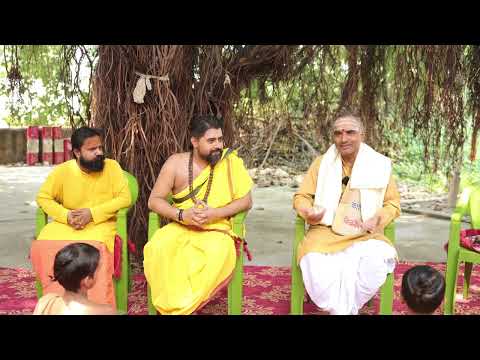 Video (Hindi) · full talkWho is an Acharya, the four marks of Dharma and the story of Shankha and Likhita — Dr. Gyanendra Sharma’s discourse at a Veda Vidyalaya in DelhiWatch on YouTube →
Key Takeaways
- An acharya is one who knows the shastra, teaches the disciple right conduct and lives it himself
- Each yuga has its own main smriti — in the Kali Yuga, that of Parashara
- Taking what has not been given — even if it is one’s brother’s — is a fault
- The shastras place the honour of the mother far above that of the father
- Follow only the faultless conduct of elders
- The four marks of dharma: the Veda, the smriti, good conduct and the satisfaction of the self
- The Vedas do not purify one who lacks right conduct
The occasion
At a Veda Vidyalaya in Delhi, founded four years ago, Dr. Gyanendra Sharma gave a discourse. Before him were the young students (batuks) learning the Veda, their teachers, and some devotees. It began with the recitation of a Saraswati vandana and the Saraswati Gayatri.
The subject of the discourse was tied to a single thread: knowledge is complete only when it enters conduct. This article sets out the main points of that discourse in simple language.
Who is called an Acharya?
Dr. Sharma began with the definition of the word acharya:
आचिनोति हि शास्त्रार्थान् आचारे स्थापयत्यपि।
स्वयमाचरते यस्मात् तस्मादाचार्य उच्यते॥
It names three tasks of an acharya:
- Gathering the meaning of the shastras — not merely memorising the text, but knowing its meaning
- Establishing the disciple in right conduct — bringing that teaching into the student’s life
- Practising it himself — living first what he teaches
Dr. Sharma’s point was clear: one who only speaks but does not act — his words do not stay in the disciple’s mind. The acharya’s own life is his greatest lesson.
Each yuga has its own smriti
The discourse explained that there are many smritis that set out the rules of dharma, and for each yuga one smriti is regarded as the main one:
- Satya Yuga (Krita Yuga) — Manu
- Treta — Gautama
- Dvapara — Shankha-Likhita
- Kali Yuga — Parashara
This does not mean the other smritis are useless. It means that the shastras made the practice of dharma simpler according to place, time and human capacity.
The story of Shankha and Likhita
Shankha and Likhita were two brothers, both rishis. Dr. Sharma told their story like this.
One day Likhita reached the ashram of his elder brother Shankha. His brother was not there. He was hungry, so he picked fruit from the garden and ate it. When Shankha returned he asked — where did you get the fruit? Likhita said: from your own garden.
Shankha said: a thing taken without asking is theft, even if it belongs to one’s brother. Go, and receive the punishment for it from the king.
Likhita went to the king. The king was afraid to punish a rishi, and out of reverence said that there was no punishment for him. But Likhita insisted that an assembly of scholars should decide. He quoted this verse:
त्रयो वा चत्वारो वा यद् ब्रूयुर्वेदपारगाः।
स धर्म इति विज्ञेयो नेतरेषां सहस्रशः॥
That is — what three or four scholars who have mastered the Veda say should be known as dharma; dharma is not decided by the opinion of thousands who do not know.
The assembly of scholars pronounced the punishment according to the law of that time, and Likhita’s hands were cut off. Likhita returned to his brother. It was the time of sandhya. During sandhya, as soon as he said "Keshavaya namah" while doing achaman, his hands became whole again.
What do we learn from this story?
- Do not take what has not been given — taking a thing not given is a fault, even if it belongs to one’s own people
- Dharma is decided by scholars — not by the opinion of the crowd, but by the counsel of those who know the Veda
- Dharmo rakshati rakshitah — he who protected dharma, dharma protected
The honour of the mother
In the discourse Dr. Sharma also answered the belief that the shastras look down on women. He explained that the Manusmriti places the honour of the mother far above that of the father. He said a hundred times, and also explained that in the interpretation of Puri Shankaracharya Niranjandev Tirtha ji it is a thousand times.
He gave a living example from the sannyasa tradition. A dandi sannyasi, who has left all worldly relationships behind, still prostrates fully before his mother, and is present at her passing. Sannyasa releases the bond with the father, but not the reverence for the mother.
The wife is called ardhangini (half of the self). In the work of dharma, husband and wife are partners together, and without the wife the householder’s yajna is not considered complete.
Which conduct of elders should we follow?
Dr. Sharma recited this teaching:
यान्यनवद्यानि कर्माणि तानि सेवितव्यानि, नो इतराणि।
That is — follow only those actions of elders that are faultless, not the others.
Gurus and elders themselves say: do not copy everything we do, adopt only the good conduct. In the discourse, the example of Parashurama ji was given to explain that not every act of great souls is for ordinary people to imitate. Acts tied to their special circumstances and capacity were theirs alone.
The four marks of dharma
The last and deepest part of the discourse was on the root of dharma.
वेदोऽखिलो धर्ममूलम्।
The whole Veda is the root of dharma. Dr. Sharma explained that the Veda contains all three — mantra, arthavada and vidhi. The vidhi tells what is to be done, the arthavada praises it and turns the mind towards it, and the mantras are spoken in that rite.
Then he gave four marks by which dharma is recognised:
वेदः स्मृतिः सदाचारः स्वस्य च प्रियमात्मनः।
- The Veda — the first and greatest authority of dharma
- The smriti — the rules of dharma written by the rishis on the basis of the Veda
- Sadachara — the conduct of good and cultured people
- The satisfaction of the self — the act that feels right to a pure heart
When two authorities seem to differ
Dr. Sharma also gave the order of decision: if shruti and smriti seem to conflict, shruti prevails; if smriti and purana seem to conflict, smriti prevails. This is the shastric propriety.
Conduct is the source of dharma
The conclusion of the discourse was in two sayings:
आचारहीनं न पुनन्ति वेदाः।
आचारप्रभवो धर्मः।
The Vedas do not purify one who lacks right conduct; and dharma is born of conduct itself.
Dr. Sharma also said that from the Veda comes yajna, and through yajna the devatas are nourished. So a batuk studying the Veda does not study only for himself — he keeps that whole tradition alive. But that tradition stays alive only when the one who studies brings it into his conduct.
A message for Veda students
- Understand the meaning along with the text
- Bring what you study into your conduct
- Do not take anyone’s thing without asking
- Respect parents and guru, and adopt their good conduct
- Decide on dharma through the Veda, the smriti and scholars
*This article is based on Dr. Gyanendra Sharma’s discourse (in Hindi). The stories and sayings are given in the form in which they were spoken in the discourse.*
Listen to Dr. Gyanendra Sharma (in Hindi)full video · on YouTubeLooking for personal guidance? Get your birth chart analysed.
Book a consultationFrequently asked questions
What is the definition of an acharya? +
One who gathers the meaning of the shastras, establishes the disciple in right conduct and practises the same himself is called an acharya.
Which smriti is considered the main one in which yuga? +
According to the discourse, the smriti of Manu is the main one in the Satya Yuga, of Gautama in the Treta, of Shankha-Likhita in the Dvapara, and of Parashara in the Kali Yuga.
What does the story of Shankha and Likhita teach? +
That taking what has not been given is a fault, even if it belongs to one’s own brother; that dharma should be decided by scholars who know the Veda; and that one who protects dharma is protected by dharma.
Do the shastras look down on women? +
In the discourse Dr. Gyanendra Sharma explained that the Manusmriti places the honour of the mother far above that of the father. Even a sannyasi bows to his mother, and the wife is called ardhangini.
What are the four marks of dharma? +
The Veda, the smriti, good conduct, and what is pleasing to one’s own self — that is, the satisfaction of a pure heart.
If shruti and smriti conflict, which should be followed? +
Shruti (the Veda). In the same way, if smriti and purana conflict, the smriti is accepted.
What does "achārahīnaṃ na punanti vedāḥ" mean? +
The Vedas do not purify a person who lacks right conduct. The fruit of knowledge comes only through conduct.